|
|
Argentine Tango—
4 beats/measure; 26 - 33 meas/min
The word tango is of African
origin, meaning drums
or dance, and it has has referred to many
different styles of
South American dance since the late 1700s. The Argentine Tango, done in
closed dance position, developed in Argentina and Uruguay between 1860
and 1890.
There was nothing proper or high-society about this
rhythm. It
was an earthy, emotional dance that has been associated with the
gauchos (cowboys) of the pampas, African slaves who had been brought to
the country, the bars and brothels of working-class neighborhoods in
Buenos Aires, and even criminal sub-cultures of the city. It began as a
male duet or duel. Each tried to outdo his partner's skill, perhaps
make fun of him, and so attract the attentions of a woman. The tango
later evolved into a rough, sexually suggestive mixed couple dance.
Pope Pius X banned tango dancing in 1914.
The tango traveled from Argentina to Spain in the late
1800s,
to Paris in 1907 and to London in 1912. It was considerably cleaned up
and in the process converted from a Latin to a Smooth rhythm —
International or English Tango. The dance came to the United States,
where some Latin features were reinstated, producing American Tango.
It's been said that "the American Tango is like the beginning of a love
affair, when you are both very romantic and on your best behavior. The
Argentine Tango is the next stage when you are in the heat of passion
and all kinds of emotions consume you. The International Tango is like
the end of the marriage, when you are staying together for the sake of
the children."
But through all these developments, the Argentine Tango
remained, and it may be that it accomplishes what no other dance rhythm
can do as well. More than any other style of dance, the Argentine Tango
is an expression of the relationship between a man and a woman. A
teacher once quoted Argentine Tango choreographer, Juan Carlos Copes,
who said,
The tango is a man and woman in search of each other.
It is
the search for an embrace, a way to be together, when the man feels
that he is a male and the woman feels that she is a female, without
machismo.
She likes to be led; he likes to lead. Disagreements
may
occur later or they may not. When that moment comes, it is important to
have a positive and productive dialogue, fifty-fifty.
The music arouses and torments, the dance is the
coupling of
two people, defenseless against the world and powerless to change
things. This is the best definition of the tango as a dance, I think.
This is a dance that expresses most of the emotions that
might
exist between a man and a woman: passion, excitement, love, romance,
tenderness, sadness, anger . . . even silliness. Argentine Tango does
not have to be somber.
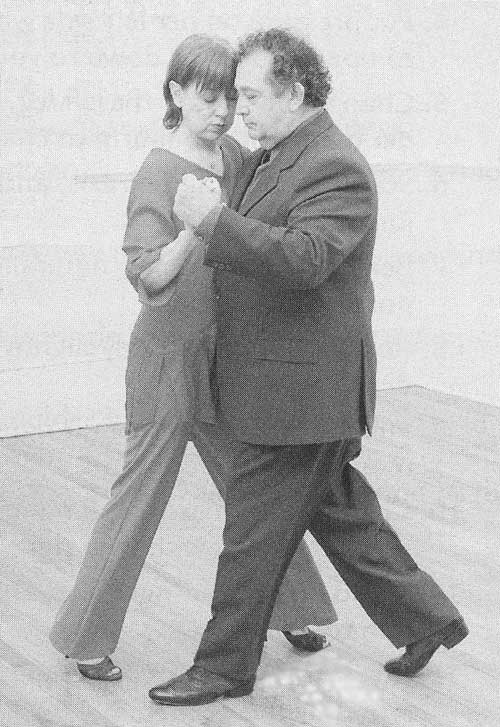
 The expressiveness
of
Argentine Tango comes out of its unique styling. More than in any other
dance rhythm, there is variety in our positions. In the closed or
embrace position, we use a relaxed upright stance. The woman has a
little forward poise, with her weight on the balls of her feet. We do
not have the raised rib cage, stretched torso, and contact at the hips
of Waltz or Foxtrot. Our eyes are not up but are level, or even cast
down. He focuses on her right shoulder, she on his left. She
concentrates on and follows his left chest and shoulder, and it is this
visual following of the movements of his torso, as much as the tactile
lead through the frame, that provides lead and follow in Argentine
Tango. The expressiveness
of
Argentine Tango comes out of its unique styling. More than in any other
dance rhythm, there is variety in our positions. In the closed or
embrace position, we use a relaxed upright stance. The woman has a
little forward poise, with her weight on the balls of her feet. We do
not have the raised rib cage, stretched torso, and contact at the hips
of Waltz or Foxtrot. Our eyes are not up but are level, or even cast
down. He focuses on her right shoulder, she on his left. She
concentrates on and follows his left chest and shoulder, and it is this
visual following of the movements of his torso, as much as the tactile
lead through the frame, that provides lead and follow in Argentine
Tango.
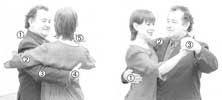
The man's right hand is lower than in the Smooth rhythms
and
farther around, in an embracing hold. He should try to reach the middle
of her back and even somewhat to her right side. Her left hand is on
his shoulder or even higher on his neck, again embracing. Lead hands
are held about at the level of the woman's mouth. We use this relaxed
(not extended) closed position, banjo, sidecar, and semi-closed, but
with variations that range from unusually tight to loose. This
variability in position is necessary to execute comfortably the
characteristic movements of Argentine Tango.
 Forward steps are taken toe-heel but
largely on the
flat of the foot. Heel leads may be used for more travel. Knees are
soft. There is little rise and fall. With each step you collect the
free foot and brush the knees and ankles together as they pass in a
smooth, slinky, level glide. One teacher asked us to develop the feel
of a "great jungle cat." Forward steps are taken toe-heel but
largely on the
flat of the foot. Heel leads may be used for more travel. Knees are
soft. There is little rise and fall. With each step you collect the
free foot and brush the knees and ankles together as they pass in a
smooth, slinky, level glide. One teacher asked us to develop the feel
of a "great jungle cat."
The progress of the dance is interrupted with a great many in-place
interactions between the man and woman. These "conversations" involve
body rotation, swiveling (ocho), catching partner's foot between yours
(trap), foot flicking or pushing (leg sweep), leg hooks (ganchos),
various leg crawls, rocking (gauchos), swiveling and flicking (boleos),
body twists or shakes (zarandeos), and various cortes. Argentine Tango
is very much in the feet and legs — twinkles, locks, kicks, and flicks.
There are unusual head positions — downward gazing,
meaningful
glances, looking away. You may look at your partner and smile — you
would never do such a thing in International Tango.
We may even go so far as to say that, while in most
rhythms
the emphasis is on correct execution of the figures, in the Argentine
Tango we strive for emotional involvement, creativity, and
improvisation.
Watch a Hurd figure clinic (mp4) on Argentine tango dance position (at 42:45) and an amalgamation of basic figures to music (at 55:00).
Figure Name,
Roundalab Phase
Level, & Timing
q=quick, 1 beat
s=slow, 2 beats
&=1/2 beat; a=1/4 beat |
Steps and
Actions That Make Up
the Figure
Each description
focuses on the man,
with the woman's footwork in parenthesis. If a woman's step is not
given, it is the natural opposite or follow of the man's. Help: basic dance
positions and steps,
actions, directions, and abbreviations. Non-standard
punctuation: a
comma separates two beats of music, a semi-colon marks the end of a
measure, and a slash (/) indicates a split beat, two things occurring
in a single beat.
|
Here are some
sequences to help
you visualize the figure in context.
|
| Basic
ss; ss; ss;
|
In closed position facing
line of dance,
point L to the side (woman point R), -, draw L to R, -; step side L, -,
fwd R blending to banjo (woman back L), -; fwd L, -, close R to L in
banjo, -;
Notice that there are 4 weight changes in 12 beats
of
music.
|
|
| Backing Basic
ss; ss; ss;
|
In CP facing line
of dance,
step back L (woman fwd R), -, back R, -; side L, -, fwd R to banjo line
and wall, -; fwd L, -, close R to L in banjo, -; |
|
| Right
Foot Basic
phase IV
ss; qqs;
|
In closed position, step back
R (woman fwd
L), -, side L turning LF to banjo, -; fwd R outside partner (woman bk
L), fwd & sd L, close R to L (woman cross LIF of R), -;
It is a little more left-side lead on step 4 that
causes
the woman to lock in front. To continue forward, perhaps to dance a
tango close, remove the side lead to unlock her feet, and she can then
comfortably step back R. It is even more important to unlock her
crossed feet if the next step is back. Her free R foot is crossed
behind her weighted L foot. Again, a little LF upper-body rotation will
signal to her that she must free her lead foot.
An interesting piece of styling calls for the
woman to
touch or to only press on step 5 and to take weight only when the man
unlocks her feet and lowers slightly for the next figure, thus
"putting" her onto her left foot. Her tango close would then have a
timing of &qqs, the "&" representing the last step of
the
previous right foot basic.
|
In the Cunninghams' Tango
D'Amor,
part A begins with a right foot basic to closed position facing line
and wall;; corte & recover; tango draw;
Hurd figure clinic (mp4) on right foot basic (at 46:30)
Hurd figure clinic (mp4), dance position and right foot basic review (at 35:40); and here (mp4), (at 40:10, and more at 44:15)
Hurd figure clinic (mp4), dance position and right foot basic at Fontana (at 0:00)
|
| Left Foot Basic
phase IV
qqs; qqs;
|
In closed position, point L
to the side
and slightly fwd (woman point R), touch L to R with no weight, step
side & fwd L to banjo, -; step fwd R, fwd L to closed position,
close R with slight LF turn to banjo (woman XLIFR), -; |
In the Moores' Fenestra,
there is
a turning tango draw to closed position facing center; left foot
basic;; back to man's ganchos (sqqs) cross swivel to lady's ganchos
(ssqqs) reverse cross swivel (s);;;; ocho & pickup; turning
tango
draw;
Hurd figure clinic (mp4) on left foot basic (at 52:15)
Hurd figure clinic (mp4), right and left foot basic review (at 45:30)
|
Double Start
qqs;
|
In CP side L small step w/ partial weight (lady sd R partial weight), draw L to R no weight, side L, -;
Note: only one weight change.
|
In Chalita
by Goss we dance from BJO LOD a closed wing , ; ,, twist vine 6 BJO
RLOD , ;; simple ocho y besos; double start; la parada; R foot
resolution;
|
Triple Start
|
In CP point sd L (W point sd R)/draw L to R, point sd L/draw L to R, sd L, -;
Note: only one weight change.
|
In Una Notte A Napoli by Goss we dance a tango draw to CP LOD; triple start side draw with lead foot; and again with trail foot; walk 2;
|
Cadencia
qqs;
|
In CP DLW ld ft free step in place L (W in place R), step R, small side L, -;
|
|
| Media Luna
s
|
Trace a half circle on the
floor with the
toe. No weight change. |
In Nina by Garza we dance a rock turn to DLW;; cadencia; R foot basic;; lady 2 slow fwd ochos;;
|
| La Piz (the pencil)
s
|
Trace a circle on the floor
with the toe.
No weight change. |
In Illusion Of My
Life by the
Nobles, the dance begins in an embrace position, right feet free, and
both lá piz and close; point side twice;; step side; finish a left foot
basic;;
(This dance is a tango vals; hence the unusual
timing.)
|
| Golpe
&
|
Tap toe on floor behind
supporting foot. |
In My Heart
Belongs To Daddy by
the DeChennes, there is an open reverse turn with ladies golpe
(qqs&); back walk 2 with ladies golpe ( s&s&);
to an open
finish with gancho; double gancho; |
La Parada or Stop
s
|
Means "the
stop." The man stops the motion of the lady by placing his foot against
hers. May or may not involve a weight change.
|
In Verano
by Hurd we dance a small back twist vine to BJO LOD; swivel lady to
SCP, step back la parada (his R against her L), leg sweep (he pushes
her L in aerial ronde); cl wing;
In Chalita
by Goss we dance a
twist vine 6 LOD to end BJO RLOD ,;; bk to ocho & pick up; dbl
start; la parada (M fwd R W bk L swvlg to SCP RLOD and then bk R to
sit); R ft resolution (M trns RF, steps sd L crossing in front of W and
leaving R against W's L);
Note that la parada can be quite dramatic. In the first example there
is no weight change, but she is not only stopped; her leg is swept back
into an aerial ronde. In the second example, there is a weight change,
she is not only stopped but led back to a sit, and the "stop" continues
into the next measure.
|
Mordida or Trap
ss;
|
The man
places both feet,
one on either side of the woman's foot "trapping" it. For instance,
suppose we dance a la parada without taking weight in the previous
measure. The woman's L is stopped with the man's L. To dance mordida or
trap, the man takes weight L, -, and then in a small ronde moves his R
to the other side of the woman's L trapping it between his feet, -;
May be performed with either foot, and the lady may trap the man.
|
In Bahia Blanca
by DeChenne we dance a quick wing in 4; circle 2 (LR for both); fwd
ronde to stop; lady trap; circle 2 (RL for both); fwd ronde to stop;
man trap; outside swivel & PU;
|
Back Travelling Trap
s&_;_,,
(ss;_,,)
|
This is a figure in 3 slows where the lady traps the man's L foot briefly. We might start CP LOD ld ft free.
In the first slow count, the M steps bk L leading the lady to a fwd
ocho. The lady steps fwd R outside partner swiveling RF, keeping feet
together, to SCP LOD. To allow the lady to step outside partner from
CP, the man must rotate his frame RF, taking his R hip back to a
contra-body position -- R hip moving back as L foot moves back.
In the second slow, the M does a close/point. The closing of the right
foot actually occurs on the &-count of the previous slow, and the
pointing of the L foot fwd and across the lady's line of dance, perhaps
toward DLW, takes the entire second slow. So the man's L foot is in
front of the lady as she steps fwd L to a second fwd ocho. Her toes
gently touch the R side of the M's L foot, she swivels on her L LF
until her weighted L foot is parallel to the M's unweighted L. She
brings her R around to the L side of the M's L foot and "traps" his
foot between her feet. It can involve a gentle squeeze, like a little
hug. Don't take weight.
In the third slow, the M simply holds, enjoying the trap. The lady can
hold her trap a moment (one beat) and then flick her R back, ending the
figure in a loose CP LOD, lead feet free, as we began.
Again, the figure takes 1 1/2 measures. We don't have as much time as my leisurely description suggests.
|
In Santa Maria by Hurd we dance a right foot basic;; bk trav traps (2X);;; start a back trav trap (2 slows instead of 3); walk 2; tango draw;
Hurd showcase of Santa Maria
|
| Zarandeo
qq
|
In a loose closed position,
use strong
upper body rotation to swivel W 1/8 RF, and then 1/8 LF, no weight
change. The woman might lift her free leg at the knee so that the
swiveling waves the lower leg side to side. |
In La Neige Tombe
by Ito, in part C, we dance a R Foot Basic, moving LOD;; slow ocho with
tap; pickup 1 slow CP LOD & zarandeo; reverse turn lady leg line;
bk wlk 2 lady leg line; twice;
|
| Boleo
qq
|
The woman bends the free knee
so that the
lower leg is parallel to the floor and then swings that foot to one
side and then the other. It can be done by the man. It can be done solo
or together. |
In Illusion Of My
Life by the
Nobles, part B begins with two steps of a right foot basic, the woman
does a left foot boleo, thru swivel, forward, and finish the basic. |
| Tango Draw
qqs;
|
In closed position facing
line, step fwd L
(woman back R), side R, draw L to R, -; Only two changes of weight.
You can turn this figure up to 1/4 LF on the first
step.
|
In the Moores' Tango
Clarice, part
A begins in closed position facing line and center with a right foot
basic;; turning tango draw to banjo facing reverse and center; back
twist vine 4; outside swivel pickup; turning tango draw to face wall;
Hurd figure clinic (mp4) on tango draw, tango close, and the tango close to right foot basic (at 50:30)
Hurd figure clinic (mp4), turning tango draw & tango close review (at 42:35)
|
| Back Tango Draw
qqs;
|
In closed position facing
line, step back
L (woman fwd R), side R, draw L to R, -; Only two changes of weight.
You can turn this figure up to 1/4 LF on the first
step.
|
|
| Tango Close
qqs;
|
In closed position, step
forward L (woman
bk R), side R, close L to R, -;
You can turn this figure up to 1/4 LF on the first
step.
|
Hurd figure clinic (mp4) on tango draw, tango close, and the tango close to right foot basic (at 50:30)
|
| Back Tango Close
qqs;
|
In closed position facing
line step back R
(woman fwd L), side L, draw R to L and take weight, -; This time three
changes of weight.
You can turn this figure up to 1/4 LF on the first
step.
|
|
| Side
Corte
s
|
In closed position step
sharply side L
(woman side R) and lower into the supporting knee, -,
A Corte should be relatively sudden, a quick pose.
|
In Fenestra
by the Moores, the
dance begins with a circle walk lady transition to closed position
facing wall, side corte recover draw;;;; to a forward step to banjo and
twisty vine toward LOD and a reverse ocho;; |
| Back Corte
s
|
In closed position step back
L (woman fwd
R) lower into the supporting knee and turn upper body slightly LF, -, |
In Libertango
by Lamberty &
Frias, part A ends with a forward step in wrapped position, -, face, -;
lower and rise with no weight change;; corte and recover to face line
and wall;; and walk to a rock turn;; |
Corte Lady Lean
s
|
This is a variation on the
back corte. Start in a closed position, lead foot free. The man steps
back L. The lady does not take a step or change weight; she simply tips
with the M's movement to an incline. The M supports the W, creating an
isosceles triangle with a small base, that is, the M does not step very
far back, but do discuss the kind of shape you'd like to make -- the
deeper the corte, the more dramatic the line. Men, be sure you'll be
able to recover and return the lady to an upright position. Ladies,
keep your head up. The head is heavy, and keeping the head upright,
rather than forward, will reduce your pressure on the man.
|
In Chalita
by Goss, we begin in a modified CP, M facing COH. The man turns his
upper body LF and presents his R side to the lady. The lady is weighted
on her R foot with the L crossed behind at the ankle. As the M steps
back, she leans forward onto the M's right side and lifts to the
toes of her R. The M recovers R and closes L, leaving trail feet free,
and we dance a basic end, moving toward DRC.
In Santa Maria by Hurd, we
begin in a cuddle embrace, M's hands on W's shoulder blades and W's
hands on his shoulders and her elbows tucked into the curves of his
elbows. Here, partners are square to each other, lead foot free. He
steps back L lady slow lean, head up. This lean stretches to 3 slows,
not just 1. She is supported by her hands pushing on his shoulders and
her forearms pressing against his toned biceps muscles. He recovers on
a fourth slow count to a La Piz/Lady Embellish; tango close; R foot
basic;; The lady's embellishment is a little flick, a golpe, maybe a
boleo or zarandeo, or anything else she can do with her R foot in one
measure. Hurd showcase of Santa Maria
|
| Advance Corte
qqs;
|
In closed position, step back
& side L
lowering into the knee and turning a little LF (woman fwd R), draw R to
L and turn to semi-closed position, step thru R to semi, -; Only two
weight changes.
This figure may turn up to 1/2 LF and it can end
in
closed position rather than semi.
|
|
| Medio Corte
qqs; sqq; ss;
|
In closed position, rock fwd
L (woman bk
R), recover R, rock back L lowering into knee, -; recover R, -, rock
fwd L, recover R; back L lowering, -, recover R, -;
This figure is done in place -- the trail foot
stays on
the same spot throughout. May turn 1/4 to 1/2 LF.
|
|
| Argentine Walks
ss; qqs; sqq;
|
In closed position facing
line of dance
step fwd L (woman back R), -, fwd R, -; fwd L, side & fwd R,
fwd L,
-; fwd R, -, fwd L, side & fwd R; |
|
| Stalking
Walks
phase V
ss; ss;
|
In semi-closed position, step
sd & fwd
L, -, draw R face ptnr and point toe thru, -; thru R in semi, -, draw L
and pt, -; |
In Orchids In the
Moonlight by
Lamberty & Halbert, there is a dip, recover; turning tango draw
to
semi-closed LOD;stalking walks;; fwd, thru, swvl to BJO; |
| Gaucho Turn
qqqq;
|
Also called Rock Turn. In
closed position,
rock fwd L turning 1/8 LF (woman bk R), recover R turning, fwd L
turning, back R turning;
You may begin this in banjo and blend to closed on
the
first step, and you may end in banjo if so cued.
|
|
| Progressive Tango Rocks
ss; qqs; qqs;
|
In closed position step fwd L
(woman bk
R), -, fwd R, -; rock fwd L, recover R, fwd L, -; fwd R, recover L, fwd
R, -; |
|
| Curving Progressive Tango
Rocks
ss; qqs; qqs;
|
Same as Progressive Tango
Rocks above but
turn 1/8 LF on each fwd step for a total turn of 3/4. |
Dance curving progressive
tango rocks;;;
and a tango draw turning to complet a full turn; |
| Cradle
ss; ss;
|
In closed position, step
forward L turning
slightly LF, -, tap R behind L (W tap LIF of R), -; bk R, -, tap L in
front of R (W tap RIB of L),-; |
|
| Reverse Turn
phase IV
qqs;
|
In closed position diag cntr
step fwd L
trng LF, sd & bk R cont trn to RLOD woman heel turn, bk L to
closed, -; |
|
Open Reverse Turn
|
In closed position DLC step fwd L trng LF (W bk R trng), fwd R trng (W sd L), bk L (W fwd R) to BJO RLOD, -;
|
In Nina by Garza we dance a curve 2 to CP DLC; rock fwd rec bk rec; open rev turn; open finish chkg; slow outside swivel twice;;
|
Open Finish
qqs;
|
In CP RLOD back R trng LF, side L trng, fwd R outside partner BJO DLW, -;
|
A standard sequence is rev trn; op finish;
|
Closed Finish
phase IV
qqs;
|
In CP RLOD back R trng LF, side L trng, close R to L CP DLW, -; |
|
| Leg
Line
ss; ss;
|
In closed position facing
RLOD, step back
R with left shoulder lead (woman fwd L looking left), -, bk L with
right shoulder lead (W fwd R flick bk L looking right), -; bk R with
left shoulder lead (woman fwd L looking left), -, bk L with right
shoulder lead (W fwd R flick bk L looking right), -;
The Leg Line is actually the woman's flick back,
bending
at the knee, and the cue often refers only to that action.
|
In Tango Misterioso
by the
Immuras, part D begins with a reverse turn; leg line;; open finish with
gancho; to a double gancho;
In The Kiss by DeChenne we
dance a tango draw LOD; walk 2; reverse turn W leg line (she flicks L
foot back); back walk 2 W leg line; open finish;
|
| Sentada
qq&s;
|
In closed position facing
RLOD, step back
R (W fwd L) turning LF, sd & bk L (W sd R) sharply turning LF,
slight rise and lower into L knee pointing knee toward wall and R leg
toward RLOD (W slight hop back L turning LF to face RLOD kick R fwd
lower into L knee sitting on man's L thigh and cross R leg at L knee,
-;
End in an L-position, right foot free for both.
The
Sentada is actually the "sit," and the cue sometimes refers to a single
step, sit, and flick. She may sit with legs parallel or even with both
feet in the air, but the sit is brief and stylized; don't lounge or
otherwise relax. May be done from other orientations.
If we dance the sentada from a same foot lunge
line, man
facing wall, then he will take 3 steps. He steps sd L (W fwd L trng
LF), behnd R (W sd R), sd L lowering and again pointing R to RLOD (W
XLIB of R to her sit position), -;
In this second example, the man is doing a "vine"
to
sentada. It helps the figure if, instead of progressing the vine LOD,
he curves it LF to DLC. His final side step becomes DLC, his L knee is
DLW, and his R leg is pointing DRW. This curved path nestles her into
her sit more smoothly and with less of a bump. One might then "vine" to
a right sentada. He steps sd R (W fwd R trng RF), behnd L (W sd L), sd
R lowering (W XRIB of L to sit), -; With a curved path, his third step
is DRC, his L leg is pointing DLW, and she is nestled onto his R thigh
more comfortably.
|
In Tango Clarice
by the Moores,
there is an outside swivel pickup; tango draw; reverse turn; back to
sentada; natural pivot 4; to a tango close;
In Burlesque
by the Garzas,
there is continuous same foot lunge with flicks;;;; vine to lady
sentada L&R;; pick up man close; double reverse;
|
| Crisscross
ss; qqs;
|
In closed position facing
wall, step side
L (woman side R) turning to semi-closed position, -, thru L turning 1/4
RF (woman 1/4 LF), -; step thru L toward reverse in reverse semi-closed
and turn 1/8 LF back to closed position, side R, and draw L to R no
weight ending in closed position wall, -; |
In the Bonds' Spanish
Shawl, part
A begins with a criss cross;; whisk; pickup; two left turns to face
line;; and tango draw; |
| Doble Cruz
sqq; qqqq;
|
In semi-closed position
facing LOD, step
fwd L (woman fwd R), -, thru R, sd L turning RF to closed position
facing wall; XRIB of L (woman XLIB of R), ronde L no weight, XLIB of R,
bk R turning LF to CP LOD;
May be done in other facing orientations.
|
In My Heart
Belongs To Daddy by
the DeChennes, there is a tango draw; contra check, recover, tap to
semi-closed position facing LOD; doble cruz;; and back to left whisk; |
| Outside
Swivel & Tap
phase V
sqq;
|
In contra banjo, step back L
and turn a
little RF (woman fwd R swiveling RF and drawing L to R no weight), -,
thru R (woman thru L), tap L side & fwd ending in semi-closed
position lead feet free; |
In Lejos Di Ti
by Lamberty,
there are curved walks toward LOD; open reverse turn; open finish
checking; outside swivel, -, pickup, tap; to forward stairs; |
| Molinete
qqqq;
|
The molinete is a rotation as a couple, with one
dancer swiveling on a spot and the other dancing a grapevine around
that point, turning the couple up to a full turn. The grapevine might
be a forward, side, behind, side, or some other sequence of side and
crossing steps describing a circle vine.
The term apparently means or
is related to
"grapevine." The figure is variable, but usually consists of one or
more steps for the man and a three-or-more–step circle vine for the
woman, turning 1/2 or more, ending in closed position. (There might be
more uniformity than this, but I haven't discovered it yet.)
A three-step variation—in CP, the man might step sd
& fwd L
turning LF (woman XLIB of R), man ronde R & continue to roatate
(woman sd R), fwd R (woman XLIF of R), - (woman swivels to face);
|
n Otra Nocheby the Clements,
there is a right foot basic;; reverse fallaway lady flick in
front; lady's LF molinete to CP LOD: S-- (QQQ-); 2X; reverse fallaway;
man's LF molinete to CP LOD: QQQQ (Q--Q); start a R foot basic;
In Nina by Garza we dance a R ft basic;; lady slow fwd ocho 2X;; lady RF molinete: S-- ---- (QQSQQS) to CP DLW;; TG Draw;
|
| Giro
qqqq;
|
A giro is a "small turn." The
man crosses
one foot behind the other, and the woman dances a circle vine or
grapevine, unwinding him.
Right Turn—In closed position, cross RIB of L no
weight,
-, -, take weight on R (woman steps fwd R beginning to turn RF, sd L
turning, bk R, sd L completing 7/8 RF turn);
Left Turn—In closed position, cross LIB of R no
weight,
-, -, take weight on L (woman steps sd R beginning to turn LF, fwd L
turning, sd R, bk L completing 1/2 RF turn);
These descriptions are based on ISTD guidelines.
Steps
and amount of turn may vary.
|
|
| La Cobra
ss;
|
In SCP LOD step through R (W L) turning RF to CP
RLOD, -, step side
and back L (woman fwd R between his feet swiveling RF and drawing L to R no weight to
SCP RLOD), -, ;
This figure is essentially a
one-step maneuver and an inside swivel or ocho. May start in
banjo and in other facing directions.
This one-measure sequence is the basic unit of the
figure, but I have never encountered a la cobra 2 as this would be
cued. The la cobra 4, which a la cobra twice to SCP LOD is probably
most common, but any number of steps are allowed. An even number of
steps ends in SCP; an odd number ends in CP. Each measure turns 1/2.
This is a recently standardized figure. In the past, la
cobra often began with the inside swivel first and then the maneuver,
so an older cue might be maneuver to la cobra.
|
In Tango Misterioso
by Immura, the dance begins with a slow cross walk 3 maneuver 1;; la
cobra 3 and thru SCP LOD;; M hold W qk circle vine 8 LF to CP DRC; turn LF to tango close; R foot basic to DLW;;
|
| Promenade
Wing Spin
sqq; q&q
|
In semi-closed position
facing DLC, step
forward L (W fwd R), -, fwd R, fwd L; hold turning LF and leading W to
wing/swivel LF on L (W fwd L/R to SCAR swivel LF on R), sd & bk
R
to end in contra banjo facing RLOD lead feet free,
I like to think of this sequence in four different
parts. First, we both take two steps down line together (sq). Next, the
man takes one step forward L and the woman does her wing in three steps
(qq&). Third (also on the &) we swivel 1/2 LF to
banjo—this
is the "spin." Finally, we both progress one more step (M bk W fwd).
Timing (e.g., sqq&; qq) and orientation
can vary.
|
In Amargura
by Rumble, part
A begins with a chase, turning chassé;; progressive link, promenade
wing spin;; to an outside swivel to promenade locks; |
| Ocho
ss; (qqqq;)
|
"Ocho" means "eight," and the
lady traces
a figure-8 on the floor with two fanning foot movements. Starting in
banjo or closed position, trail feet free, the man swivels 1/8 RF on
his left foot leading the lady to step forward R outside the man
fanning the left leg CW in a small circle and turning 1/2 RF to a loose semi-closed
position. Then he swivels 1/8 LF and leads her to step fwd L fanning
the right leg CCW and turning 1/2 LF to closed position. The man
swivels slow, -, slow, -; The woman does a step, fan, step, fan, tracing a figure-8 on the floor.
A more compact form of the figure reduces the arc of the free foot. The
lady steps forward, swivels on that weighted foot and collects the free
foot next to the weighted foot, ready for the next lead. The "figure-8"
is less rounded, more narrow. This "collection" is especially valuable
if you are dancing a series of forward and back ochos (see just below),
or boleos (above) or other flourishes.
Most of the time, the man leads an ocho without
taking a
step through rotation of the upper body, but he can strengthen the lead
by taking a step and then rotating, much like an outside swivel.
However, I must say that an ocho is not an outside swivel. It is
closer, more collected, more intimate, more sultry. If the woman holds her attention on
his left shoulder as she traces out her figure-8 and keeps herself into
him, then we have an ocho. If she looks up and left and perhaps extends
her body up and back, then we have an outside swivel.
In leading an ocho with a step, the man might step
back
L with RF upper-body rotation and then forward R with LF upper-body
rotation. Different styling has the man stepping sd & fwd L
with RF
upper-body rotation and then sd & fwd R with LF upper-body
rotation. In either case, it is the upper-body rotation that leads the
woman's actions. The first option here gives us a together
look and the second an opposition look.
|
To the extent that ochos are
danced like
little outside swivels, we will do them with opposite footwork, but we
can do them with same footwork too. In Dance In Portugal by Hurd, part C begins with a right foot basic man transition with a
touch (R feet free for both);; man rocks and woman does two slow
forward ochos;; swivel to 2 back ochos;;
In dancing the ocho with same footwork like this, the man can face the
woman directly as she steps and swivels in front of him and not off on
his right side. It feels quite intimate, quite "Argentine."
Note the additional variations here: the term
"ocho" is
used to represent just one fanning movement, and each step-fan occupies
a whole measure.
Hurd figure clinic (mp4), ochos, both forward and back, and with lift and tap (at 9:20)
|
| Back Ocho
s
|
In banjo position, step
forward R with
left-side lead checking (lady bk L swiveling RF to SCP with a small
ronde of her R leg), -,
Note that this is a cue directed specifically to the lady. It is the
lady who steps "back" to her swivel, not the man. We are well used to
cues being for the man. We hear "back basic" or "back walk" and the man
steps back. "Back to outside swivel" and the man steps back; the lady
steps forward. But "back ocho" is aimed at the lady and the man needs
to lead her to step back, maybe with a forward step, a side step, or
just body rotation, depending on the choreography.
|
In Fenestra
by Moore, part
A begins with a forward step to BJO DLW,
twist vine 4, reverse (or back) ocho, step back in SCP, to a leg sweep and closed wing.
Hurd figure clinic (mp4), ochos, both forward and back, and with lift and tap (at 9:20)
|
| 3 Slow Ocho
ss; ss; ss;
|
Ocho terminology is not well
standardized.
If you think of the meaning of the term -- "eight" -- then one ocho
should consist of two fanning leg movements by the lady, but sometimes
the cue "ocho" refers only to one "step, swivel" action. Furthermore, a
slow ocho can take a whole measure -- step on a slow count and swivel over
the next slow count. When the tempo is slow, the man has time to do
some especially suggestive leg action.
|
In the Cunninghams' Tango
D'Amor,
part C begins with 3 stalking walks;;; thru to a basic ending checking;
to 3 ochos ending in semi-closed position;;; thru face close &
tap; |
Ocho with Lift and Tap
ss; ss; ss;
|
Start in closed position facing LOD and step back
L
(woman steps forward R outside partner and might fan her left leg in a slow
arc CW). The man has left his right leg extended down line, and while
she is turning RF, he moves his R leg toward her until it touches her L
leg as it comes around. He stops her movement and forces her to
step over that leg. As she does so, she can perform a little leg crawl
or leg caress (see Lustrada below) with the instep of her L foot. The
man takes no more steps, but he leads her with upper body rotation to
step fwd L. He will rotate 1/8 LF causing her to rotate LF and to fan
her R leg CCW. Again, he moves his R leg toward her and blocks her
motion. For the third ocho, she slowly steps over his leg and again
fans her L leg CW. |
In Una Notte A Napoli by Goss
we dance a L-foot basic lady leg lift ;; back to lady's fwd ocho M tap; 2 ochos w/ lift & tap; lady step over to bicicleta lady pick up; tango draw;
Hurd figure clinic (mp4), ochos, both forward and back, and with lift and tap (at 9:20) |
| Doble Ocho
ss; ss;
|
This figure is two cross
swivels with man
and woman performing the "ocho" fanning movements.
In sidecar position facing line and wall, step
forward L
(woman bk R) and slowly swivel LF to banjo position facing COH; fwd R
and swivel RF back to SCAR position again;
|
In Una Notte A Napoli
by Goss we begin with la piz; bk corte w/ leg crawl; rudolph to sync
fallaway twist vine 5 SCAR checking lady slow flick;; back doble ocho
CP DLW ,, (a half-measure not carried forward) L-foot basic lady leg
lift ;;
|
| Ocho Para Atras
qqqq; qqqq;
|
You can think of this figure
as four cross
swivels, from banjo to sidecar to banjo to sidecar to closed. Both
perform these fanning movements.
In banjo position, the man XLIBR, and fans his R
CW
turning 1/2 RF to sidecar position (woman steps fwd R and fans L CW
turning 1/2), XRiBL, fan L CCW turning 1/2 LF to banjo (woman fwd L and
fan R CCW); XLIBR, and fan R CW turning 1/2 RF to sidecar position
(woman steps fwd R and fans L CW), XRIBL, fan L CCW turning 1/2 LF to
closed position (woman fwd L and fan R CCW);
|
|
| Lustrada
s
|
Lustrada is a "shoe shine" and
is the
rubbing of the toe of the shoe along the calf of the leg. The man might
polish one toe on his own calf for a bit of humor, or the woman might
polish her toe on his calf (or even above the knee) for a more erotic
effect.
Might be done in a variety of positions and
orientations.
|
In Orchids In the
Moonlight by
Lamberty & Halbert, there is a series of slow swivels with
lustrada. For instance, in banjo, the man steps back L and the woman
steps forward R and swivels to semi. He slides his right foot to the
right to tap her right foot, and she responds by shining her left shoe
on his right calf, and then steps over his right leg and swivels to
banjo. These swivels seem to be ochos (we haven't danced this one). On
the last swivel, she "polishes vigorously," and Lamberty suggests that
"M may look with disbelief at W." |
| Barrida
s
|
The sweeping of the foot to
one side or
the other. In a series of Ochos, the man might sweep his free foot back
and forth, playing with the woman as she dances her swivels.
In a facing position, he might place his foot next
to
hers and then step and slide her foot, pushing with his.
|
|
| Gancho
s
|
Gancho means "hook," and the
gancho is a
flick of the lower leg back and around the adjacent leg of the partner.
Sometimes the cue represents the flick only, and sometimes it
represents a step with one leg and a flick with the other. The move is
quick. Wrap your leg around that of your partner and just as suddenly,
remove it. It is flame-like, "limbs licking limbs, as if embracing with
arms offered not enough heat." (from Tango,
Thompson, 2005)
In a hip-to-hip banjo position, the man steps fwd
R
turning LF to give the woman access to the back of his R leg (she steps
back L turning and flicks her R foot back and around his R, bending at
the R knee)
In this position, he could then step back L and
she fwd
R turning RF a little and he could flick his R back and around her L
for a Double Gancho.
One of our teachers (woman, of course) recently
suggested that when we do a woman's gancho, she should hook sharply,
"as if she meant to do the man some damage." She probably can't reach
high enough to hit anything delicate, but she might suggest or hint
that she could. Yes indeed, Argentine Tango is suited to convey a wide
range of emotions between a man and a woman, even tongue-in-cheek
aggression or self-defense. 
|
In the Goss' Jealousy
Tango, there
are slow ochos and a pickup;;;; open reverse turn; open finish with
gancho; double gancho; outside swivel thru tap;
Note that this sequence contains both uses of the
term
gancho. In the open finish with gancho, the gancho is only the flick.
In the double ganchos, each is a step and flick.
Hurd figure clinic (mp4), open reverse turn with gancho; double gancho (at 46:00 and more at 48:05)
|
Doble Gancho
sqq; s
|
In a
side-by-side BJO
position, M fcg DLC & W fcg DRW, ld ft free, step back L (W fwd
R)
trng LF to present your back to the lady and lift the R leg to hook the
back of the W's R leg, -, recover R (W rec L) trng RF, trng step sd L
(W sd R); swivel RF on R & stp sd & bk L on a soft knee
fcg DRC
(W bk L fcg DLW) to lift the L leg to hook the back of the W's L leg ,
-,
We can think of this sequence as a step back to M's gancho and then a
twist vine 3 to another M's gancho. This is a man's doble gancho.
In a lady's doble gancho, the figure is mirrored. The man steps forward
with inside foot and the lady back to a lady's hook, and then we
recover to a twist vine 3 to another lady's hook.
|
In Dance the Night Away
by Worlock we dance a turning right-foot basic to CP LOD;; back to M's
gancho and then W's doble gancho;; both ocho to BJO DLC and then M's
doble gancho;;
In Fenestra
by Moore we dance
a L ft basic to CP RLOD;; bk to M's doble gancho ; ,, fwd both ocho , ;
fwd to lady's doble gancho ; ,, bk both ocho , ; W ocho & pick
up
to CP DRW;
|
| Bicicleta
qq
|
The trick to this figure is
to get into
position, not to perform the action (which is supposed to mime the
pedaling of a bicycle). So, begin in contra banjo, trail feet free,
woman's L leg extended back, and man's R leg pointed between her feet
(behind her supporting R foot and in front of her free L foot. The
figure is simply the raising of the man's R leg such that he lifts the
woman's L ankle with his instep. Raise her L foot until his R thigh is
horizontal, and then lower her foot back to the floor. There is no
weight change.
I suspect that this figure could be performed with
either foot and that it could be repeated for stronger effect.
|
|
Some
material from this page was
reprinted as
“Tango, Argentine and International,”
Roundalab Journal, 32:2, p.17–18, fall 2008.
|